
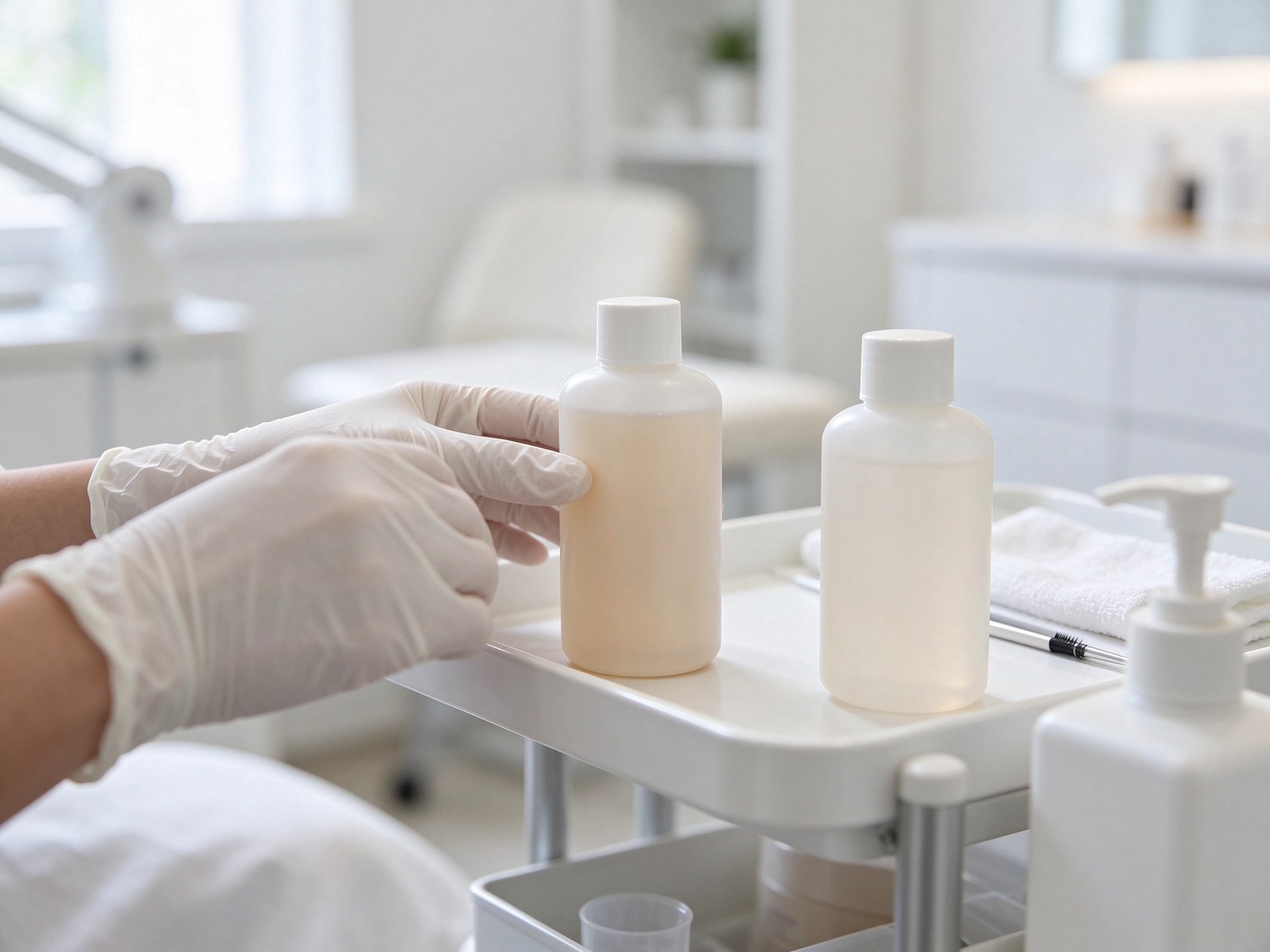
Lash lift solutions are a system, not a collection of liquids that happen to sit on the same shelf. Each step has a job, a timing and a sequence. Mixing them — blending leftovers, topping up one bottle with another, or combining formulas from different systems — removes the structure the service depends on and introduces variables that are hard to see and impossible to troubleshoot.
>Why mixing is a problem at all
Lifting chemistry softens the lash, reshapes it, then sets it in the new position. That sequence only works when each product is used as designed, within its own timing. A mixed solution is no longer part of any system, so the result is no longer predictable — and predictability is the entire basis of a professional service.
Seven specific consequences are worth understanding.
1. Results stop being repeatable
Consistency comes from controlled processing. A salon needs the same outcome across different lash types, service lengths and technicians. Even a small blend of leftover solution can shift how lashes process, and inconsistency shows up in rebooking rates, retail recommendations and the salon’s reputation long before it shows up in a single client’s photos.
2. Timing guidance no longer applies
Processing time is chosen from lash thickness and condition, within the guidance that belongs to a specific product. A mixed formula may process faster or slower than that guidance allows, which turns a trained decision into guesswork on a service that happens inches from the eye.
3. Lash health is put at risk
Mixed solutions raise the chance of over-processing, uneven softening and poor setting. The visible result is lashes that look frizzy or inconsistent; the invisible result is stress on the natural lash that the client pays for over the following weeks.
4. The lash line processes unevenly
No lash line is uniform. Inner corners, the centre and the outer corner often respond differently because length and density vary. A mixed solution adds another variable to a service that already demands precision, so some sections lift strongly while others under-process or drop early — and tint or styling on top cannot hide the imbalance.
5. Troubleshooting becomes guesswork
When a lift does not meet expectations, the professional reviews timing, lash condition, rod or shield choice, placement and aftercare. If the formula itself is unknown, that review has a blind spot. A clean product process keeps the variables countable and makes improvement possible.
6. Product integrity is compromised
Solutions need correct closure, clean handling and protection from air. Decanting, topping up and blending expose them to contamination and formula imbalance before they ever reach a lash. A product of uncertain condition cannot deliver a certain result.
7. Bad habits spread through the team
Salons train several technicians to one standard. Mixing creates informal shortcuts that do not match the training or the directions, and those habits replicate quickly. A protocol that is simple, written down and repeatable is far easier to coach than one that depends on individual judgement about what is left in a bottle.
What to do instead
- Use each solution exactly as directed, from one system.
- Never combine leftovers from different applications.
- Store products as the label requires, sealed and away from heat.
- Keep tools clean and the station organised so the right bottle is easy to identify.
- Train everyone to one written lift checklist.
- Replace product that is questionable instead of stretching the last of it.
None of this is expensive. It is simply the difference between a service that can be repeated and one that has to be hoped for.