
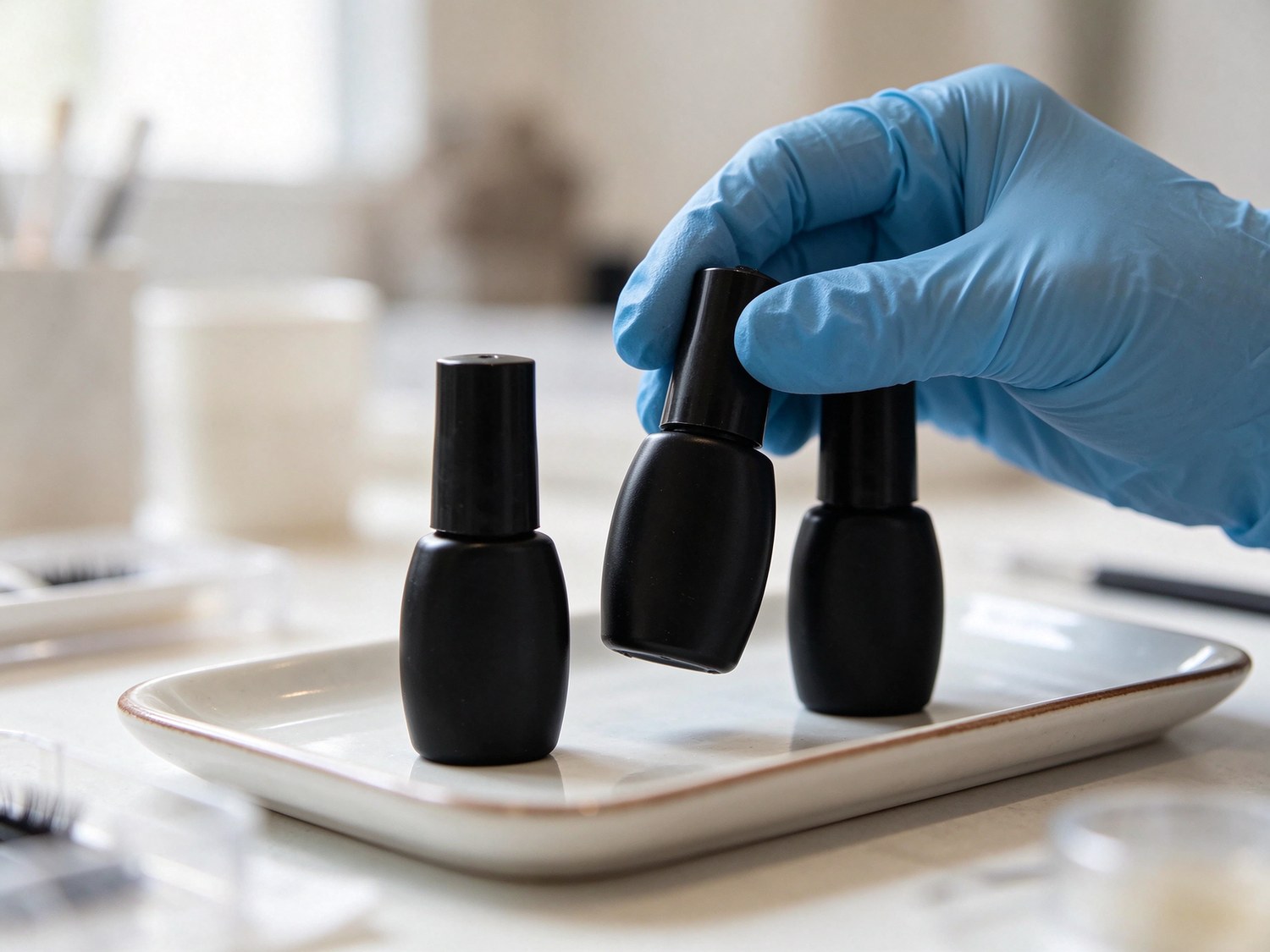
Every lash artist eventually asks which adhesive is the best one. The honest answer is that there is no best adhesive — only the bottle that matches your working speed, the room you work in and the lashes in front of you. The label rarely tells you that. The specification sheet does, and three figures on it will settle most of the confusion.
>The three numbers that decide whether a bottle suits you
Cure time, viscosity and working range. Cure time is the number of seconds between placing a lash and the bond setting. Viscosity describes how freely the glue flows and how much of it a lash picks up. Working range is the temperature and humidity band in which the formula behaves predictably. Everything else — colour, bottle design, price per millilitre — is secondary.
Most artists shop by cure time alone, then wonder why the same bottle that behaved in March misbehaves in July. The range figure explains it. A formula rated for 40–60% humidity at 18–24°C is a narrow-band product: excellent in a controlled room, unreliable in a heatwave or a dry winter studio. A wide-band formula rated from 15–35°C and 15–85% humidity is less sharp but far more forgiving, and it is the safer choice for anyone working in a room they cannot fully control.
Cure speed should match your hands
Adhesives fall into rough bands, and each band answers a different problem:
- 0.5–1 second. Built for experienced artists who place a lash once and leave it. There is no time to adjust position, so technique has to be settled before the bottle is opened.
- 1–2 seconds. The working standard for classic and volume sets. Enough time to isolate and place, fast enough that a full set does not run long.
- 2–3 seconds. A learning speed. It allows a student to check isolation and direction without the bond setting mid-adjustment.
- Around 2 seconds, wide range. A flexible formula that tolerates changing conditions — the sensible default for a beginner or a shared studio.
Faster is not better. When a bond sets before the lash is in its final position, the base cures under tension or at the wrong angle. Those bonds feel hard and look acceptable on the day, then shed within five to seven days because the attachment was never clean. Fast glue also removes your ability to fix a mistake, which is exactly the skill beginners need to keep.
Too slow brings its own problems: lashes slide while the glue is open, stickies appear between neighbours, the client waits longer with fumes nearby, and a full set stretches past the time you priced. The rule worth keeping is simple — choose the slowest adhesive you can work with comfortably, not the fastest one you can survive.
Viscosity is about control, not quality
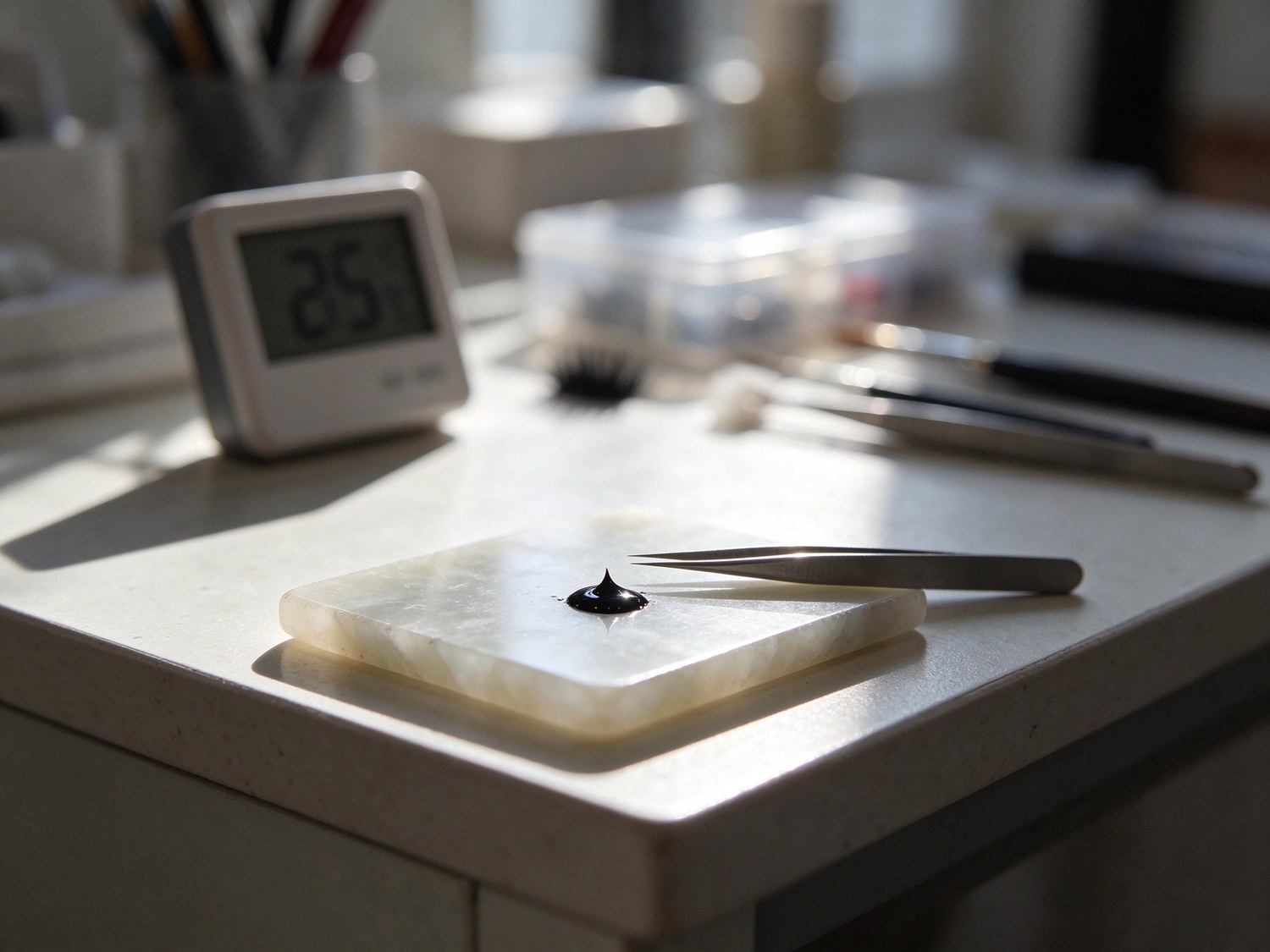
A thin adhesive flows quickly, so a lash picks up a smaller amount and the bond stays light. That suits fine natural lashes and volume work where extra product would weigh a fan down, but it is less forgiving on a hot, humid afternoon when the drop thins further. A medium viscosity holds its bead on the jade stone, gives more visual feedback and is easier to judge when you are learning. Neither is superior; the mismatch is what causes trouble, usually a medium glue used on very fine lashes or a thin glue used by hands that are still slow.
The climate envelope matters more than the marketing
Most adhesives are formulated for 18–24°C and 40–60% relative humidity. Outside that band the chemistry changes rather than fails: warmth speeds curing and thins the consistency, cold slows it, dry air delays it, humid air accelerates it. A room that swings through the day produces a bottle that behaves differently at 10am and 4pm, which reads as inconsistent technique when it is really inconsistent conditions.
Measure the room rather than guess it. A small hygrometer beside the lash bed tells you more than any product description. If the numbers cannot be held — a mobile studio, a shared salon, a heatwave — a wide-range formula plus two method changes will do more for retention than a more expensive bottle: smaller, fresher drops, and a conscious check of how much product the lash is actually picking up.
Clear and carbon-free formulas for sensitive clients
When a client reports itching or redness, artists often blame the black pigment. The more likely culprit is the cyanoacrylate monomer, which is present in clear adhesives too. That said, some clients genuinely tolerate a clear, carbon-free formula better, and carbon black can slightly accelerate curing, so a clear version can also behave a little more calmly in a warm room. It is as strong as its black equivalent; it is simply less visible during application.
Treat a switch to clear as a comfort measure, not a cure. Patch test, record consent, and refer any client with swelling, lid oedema or a reaction that worsens with each set to a doctor rather than experimenting on the lash line.
The care routine that protects performance
A good bottle performs badly when it is stored badly, and most “bad batches” are storage problems. What matters:
- Upright, cool, dark and dry. Not a car, a sunroom, a radiator shelf or a window ledge.
- Unopened stock can go in a fridge at 2–10°C for up to three months. Once opened, it must never return to the fridge; condensation puts moisture into the bottle and shortens its life dramatically.
- Let a cold bottle reach room temperature before opening it. A cold bottle used straight from the fridge condensates as it warms.
- Never decant. The bottle and its liner are designed for the formula; a travel container or a glass jar will not protect it.
- Keep it away from primers and cleansers. Their ingredients can start polymerising the adhesive in storage.
- Label the opening date and rotate stock first in, first out. In normal use, replace four to six weeks after opening rather than waiting for symptoms.
- Shake properly. Thirty to sixty seconds by hand, or about three seconds on a shaker, before every use. Under-mixed adhesive looks grey or speckled because the pigment has settled, and it bonds poorly long before the bottle is empty.
- Clean the nozzle with a lint-free wipe, never cotton. Cotton fibres react exothermically with cyanoacrylate and can soften and eventually snap the plastic neck. Never push dried glue back down the nozzle; remove and replace it instead.
Four questions before you buy
How fast do I actually place a lash, not how fast do I want to? What is the real temperature and humidity range of my room, measured over a week? Are my clients fine-lashed, oily, sensitive, or a mixture? And do I want one adhesive for everything, or two — a steady one for everyday sets and a faster one for volume days?
Answer those honestly and the choice stops being a matter of opinion. A bottle that matches your hands and your room will outperform a “better” bottle that does not, every single week.