
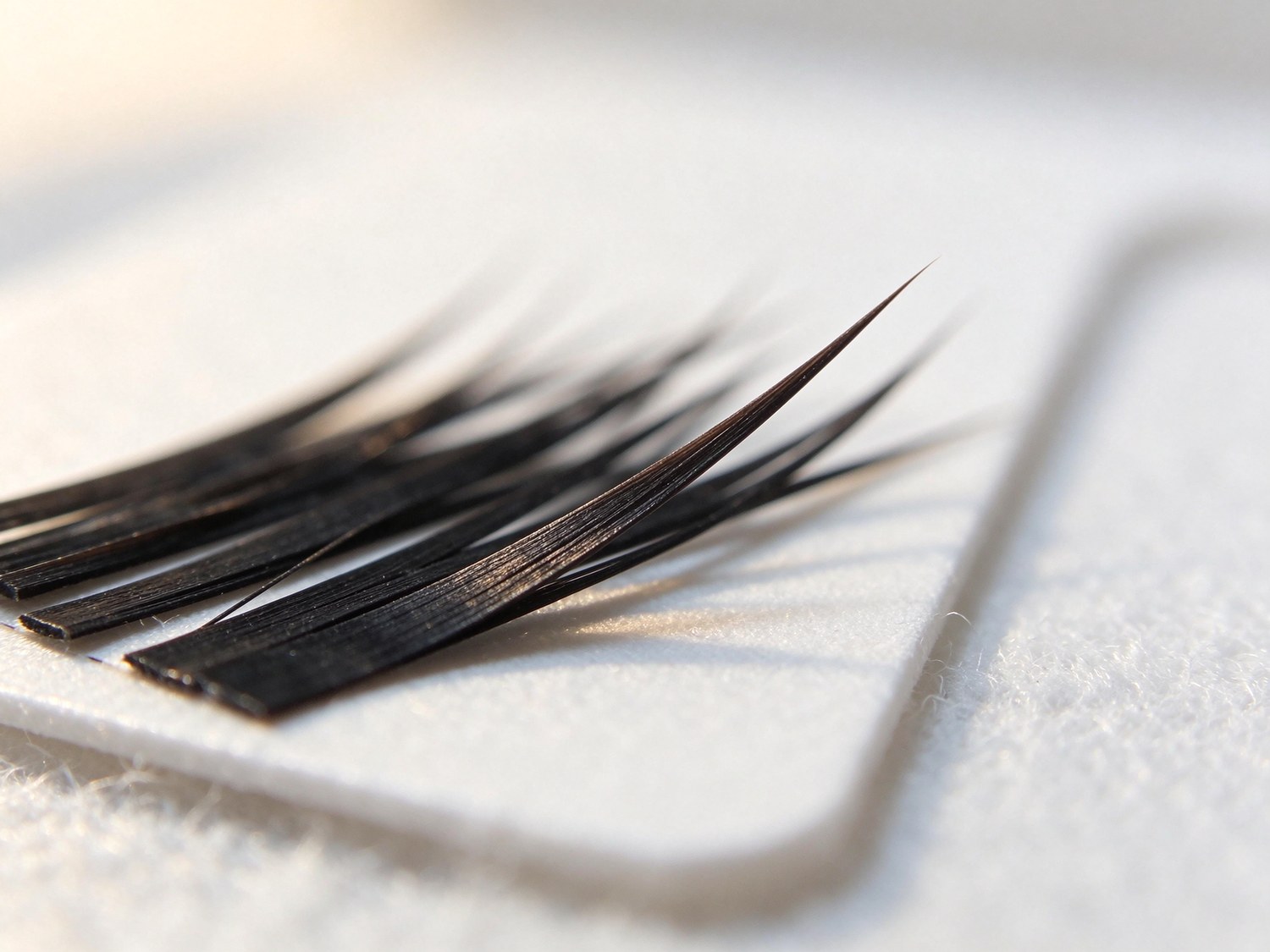
Flat lashes solve a specific problem that classic lashes cannot: a lash line with gaps. The fibre has an elliptical or flattened cross-section rather than a round one, so its base is wider and sits across more of the natural lash. The result is a darker, denser line and better coverage of sparse areas without adding row after row of extensions.
>What “flat” actually means
A standard lash is round in cross-section. A flat lash is pressed or extruded into a wider, thinner profile, which gives it two practical differences: the contact area with the natural lash is larger, and the visible base is broader. That broader base is what creates the eyeliner effect along the lash line, and it is why flat lashes hide gaps that a 0.07 round lash simply passes through.
Flat lashes are usually thicker than classic fibre — commonly in the 0.15 to 0.20 mm range — because a very thin flat lash would collapse rather than hold its shape. That thickness is the reason they are not a universal upgrade: they are heavier than a classic lash of the same length, so they belong on clients with reasonably strong natural lashes, not on fine or damaged ones.
Where flat lashes earn their place
- Sparse or gappy lash lines, where the goal is to reduce visible skin between lashes rather than add length.
- Clients who want a defined, liner-like base without a full volume set.
- Lash lines that photograph poorly, because the wide base reads as density on camera.
- Fill-in work where a few flat lashes through a patch even out a map that would otherwise look striped.
- Mixed sets, using flat fibre in the centre and finer classic lashes at the corners for softness.
Where they do not belong: very fine natural lashes, clients with a history of premature shedding, and any lash line showing damage from previous over-weighting. Weight is the variable that matters, and flat fibre adds it quickly.
The cross-wrap shape and application flexibility
Some flat lashes are manufactured with an interlocking cross-section that wraps around the natural lash rather than sitting flat against one side. The practical benefit is directional: the extension can be attached from the top, the bottom, or either side and still find a stable contact point. For an artist working around a difficult growth direction or a lash that curves sharply, that flexibility reduces the number of lashes that have to be abandoned mid-set.
It does not remove the need for isolation. A wide base that bridges two natural lashes will still create a sticky, and a sticky on a flat lash is harder to separate because the base is broader.
Mixing flat with classic
The most wearable result is rarely a full set of flat lashes. A common approach is to use flat fibre through the body of the set for density and switch to finer classic lashes at the inner and outer corners, where natural lashes are thinner and more delicate. Something in the 0.07 to 0.05 mm range at the corners keeps the set from looking blocky and protects the lashes most prone to damage.
Keep the map deliberate. Flat lashes at the inner corner add weight exactly where lashes are weakest, and a heavy inner corner is the first thing a client notices when a set starts to feel uncomfortable.
Retention and aftercare
The larger contact area usually means better initial adhesion, and clients often report that flat sets hold well through the first two weeks. The risk shifts to the natural lash rather than the bond: if the fibre is too heavy or the attachment angle is wrong, the extension can pull the natural lash early. Check the direction of every flat lash during application, and be willing to go down a length rather than up a thickness.
Aftercare is the same as any set — cleanse daily, avoid oil-based products on the lash line, do not rub, and book the infill at two to three weeks. The one addition worth mentioning: because the base is wider, residue and makeup collect more visibly at the lash line, so a thorough cleanse matters more than it does on a fine classic set.
How to decide in the chair
Look at the lash line with the client sitting up, in the light you will actually work in. If the gaps are structural — sparse patches, scar lines, uneven density — flat lashes will do more than extra length. If the lashes are fine and evenly spaced, a shorter classic set will usually look cleaner. And if the client’s natural lashes are already stressed, neither option is the answer; a break and a conditioning plan come first.