
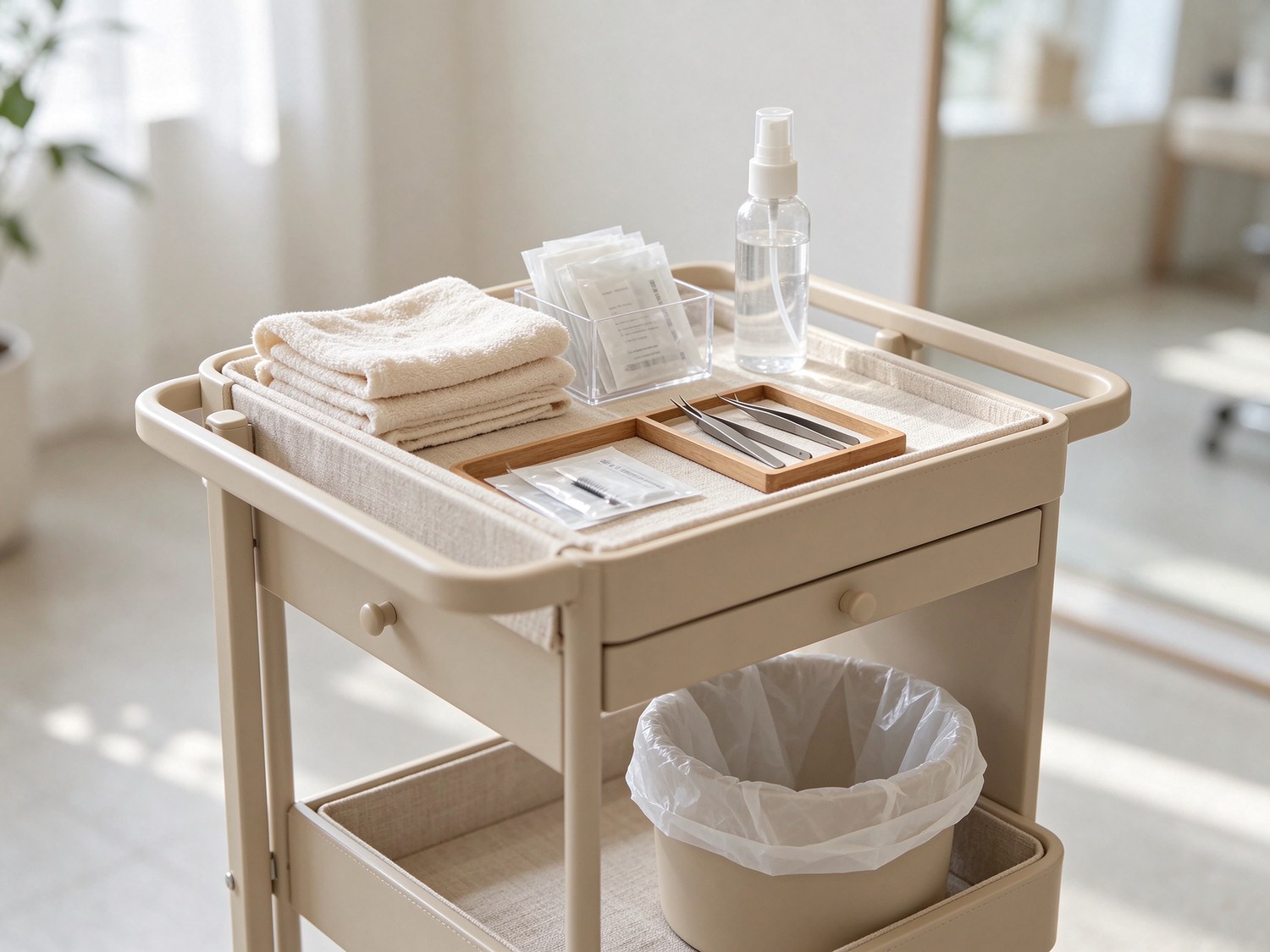
Back-to-back appointments look efficient on paper. In practice, a diary with no gaps is the fastest route to a sore neck, a messy trolley and a rushed last set — and the fifteen minutes you “save” by squeezing in one more client usually costs you far more than it earns. Leaving a buffer between clients is not a luxury; it is the cheapest operational upgrade available to a solo lash artist.

>Reset the station, not just the bed
A ten to fifteen minute gap is the only realistic window in which to do the things that keep a treatment room compliant and quick. Clear used disposables, change the bin bag if it is full, wipe the trolley and bed, restock tapes and lint-free pads, and lay out the next client’s mapping card before they arrive.
Doing this between clients rather than at the end of the day also means you notice problems while they are small. A trolley that has been “fine all week” reveals a missing product or an unlabelled bottle when you look properly, not when you are already mid-set.
Move, stretch and look at something far away
Lashing is a static, close-focus job. Even a client who arrives with perfect posture leaves most artists hunched over a brow with the shoulders rounded and the neck forward for a couple of hours. Ten minutes of standing, walking and a few slow shoulder rolls interrupts that pattern before it becomes the day’s default position.
Your eyes need the same break. Focusing on lashes at 20–30 cm for hours strains the muscles that control focus; looking across the room, out of a window or at something distant for a minute relaxes them. Artists who work five sets in a day and never look up are the ones who finish the week with headaches and blurred vision by Friday evening.
Eat, drink and blink before you crash
Most lash artists do not get hungry during a set — adrenaline covers it — and then hit a wall at 4pm. A buffer is the natural place to drink water and eat something small. It sounds trivial until you notice that the sets you are least happy with tend to be the ones booked straight after five hours without food or liquid.
Absorb the unplanned
Clients arrive late. A set needs more work than the consultation suggested. A patch test question turns into a ten-minute conversation about aftercare. Without a buffer, every one of those events eats into the next client’s appointment, and the person who pays for it is usually the client at the end of the day, who gets a rushed set and an apologetic explanation.
Ten to fifteen minutes between bookings means a late arrival stays a late arrival instead of becoming your problem, and you keep the standard you set at the start of the day. It also protects the one thing clients judge hardest: whether they felt like the only person in the room.
Building buffers without losing bookings
The objection is always the same — fewer slots means less income. In practice most artists recover the time by tightening the structure rather than by opening more hours:
- Book to a fixed appointment length that includes consultation, set-up and aftercare, not just the application.
- Use a 10–15 minute buffer between clients and protect it the way you protect a client.
- Keep one longer block at the end of the day for overruns and admin, instead of scattering the overflow across the diary.
- Give first-time clients the longer slot they actually need; new sets almost always take more time than infills.
Run it for a month before deciding it has cost you money. In most cases the diary ends up slightly shorter and the takings end up the same or higher, because fewer rushed sets means better retention and fewer re-dos.
Telling clients what the gap is for
Clients notice buffers and sometimes read them as a sign you are not busy. A single sentence fixes that: “I leave a few minutes between clients to reset the room and set up properly for you”. Framed as hygiene and preparation, the gap reads as professionalism rather than downtime.
It also helps to be clear about the intervals that matter to them, since it saves a lot of mid-appointment questions:
- Infills are normally due every two to three weeks, because the natural lashes shed at a rate of roughly two to five hairs per eye every day and the set slowly thins out.
- A client does not need a “rest” from extensions provided the weight is appropriate, isolation is correct and they cleanse daily with an oil-free product. Continual wear for years is normal for well-maintained sets.
- A lash lift needs six to eight weeks between appointments. The service restructures the hair, and repeating it sooner over-processes lashes that have not yet been replaced by fresh growth.
None of that is complicated. The whole system is one decision — that your diary has gaps in it on purpose — and the discipline to keep them when a client asks for “just one more slot”.