

A lash set that looks beautiful in the treatment room can look almost invisible on a video call. Webcams compress the image, flatten contrast and soften detail, and the lighting most people use at a desk comes from above and in front. The result is that fine, long lashes disappear, while heavy sets read as dark bars. Designing for the camera is a different brief from designing for daylight, and clients who spend their working day on calls are asking for it more often.
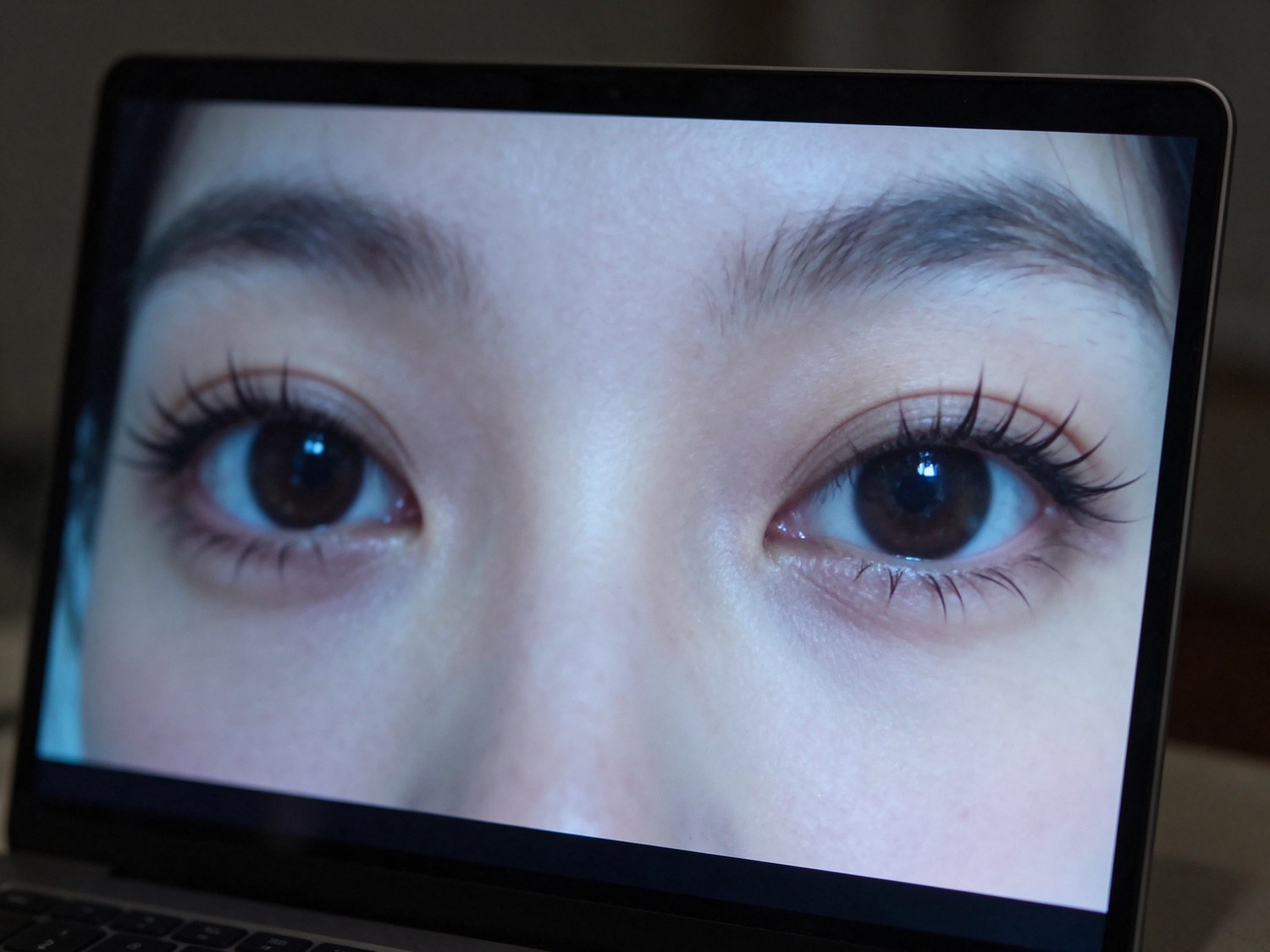
>What the camera does to a set
Three things happen to lashes on screen:
- Resolution drops. A 1080p webcam at normal call compression cannot resolve individual fine lashes. Density reads; length alone does not.
- Contrast flattens. Black lashes against a bright screen or a white wall lose their edge, and very dark sets can look like eyeliner rather than lashes.
- Lighting comes from above. A ring light or a monitor casts shadow downward, so lashes that curl only slightly vanish into the lid; curl is what lifts the tips into view.
Curl first
On camera, curl matters more than length. A slightly stronger curl than you would choose for daylight brings the tips up and forward so they catch the light and sit against the iris rather than the lid. Extremes work less well: a very tight curl reads as a circle from a front-facing camera and can look unnatural in a still frame.
Test it before committing. Ask the client to open a video call or a selfie camera in the room, with her usual lighting, and look at the preview rather than at her face. The difference between a C and a D curl is often obvious on screen and invisible in the mirror.
Density over length
Because the camera cannot resolve fine detail, a medium-density set with moderate length reads fuller than a long, fine set. Two practical rules:
- Reduce maximum length by roughly one step from what you would choose in person, and add density instead.
- Keep the inner corner short. A long inner section looks heavy on a front-facing camera and closes the eye in the frame.
Keep weight in mind: density adds weight, and the client’s natural lashes still have to carry it for three weeks. Medium density with a clean base is the reliable compromise.
Shade and contrast
Pure black is dramatic in daylight and can read as a solid line under a ring light, especially on camera feeds that crush shadows. A black-brown set, or a black base with brown spikes, keeps definition without the hard edge. Clients with fair skin and light eyes benefit most from the softer shade; clients with dark lashes and deep-set eyes can carry black without losing separation.
Makeup and framing
The makeup that works on camera is the makeup that avoids shimmer and heavy product at the lash line. A thin line above the lash roots, applied with a water-based liner, defines the eye without softening the adhesive. Shimmer shadows create compression noise and draw attention away from the lashes; matte, mid-tone shadows keep the focus on the set.
Coach the client on framing as well, because no set can compensate for a bad camera angle:
- Put the light in front of the face, not behind it.
- Set the camera at eye level or slightly above, not below the chin.
- Tilt the chin down a few degrees; it opens the eye and shows the curl.
- Avoid sitting with a bright window directly behind the chair.
A short screen test
Before the client leaves, run a two-minute test: same room, same light, same laptop, eyes open, then looking down at notes, then a slight smile. If the lashes disappear when she looks down, the curl is too soft. If the set looks like a heavy band across the lid, the density or the length at the inner corner is too much. Adjust at the refill rather than promising a fix that never comes.
Camera-facing clients are a growing segment, and they judge the result by a screenshot rather than by a mirror. Designing for that view is a small change in curl, density and shade, and it turns a set that looks fine in the studio into one that works in the meetings the client actually attends. LebestPro’s curl range and black-brown options make that adjustment straightforward at the lash bed.