
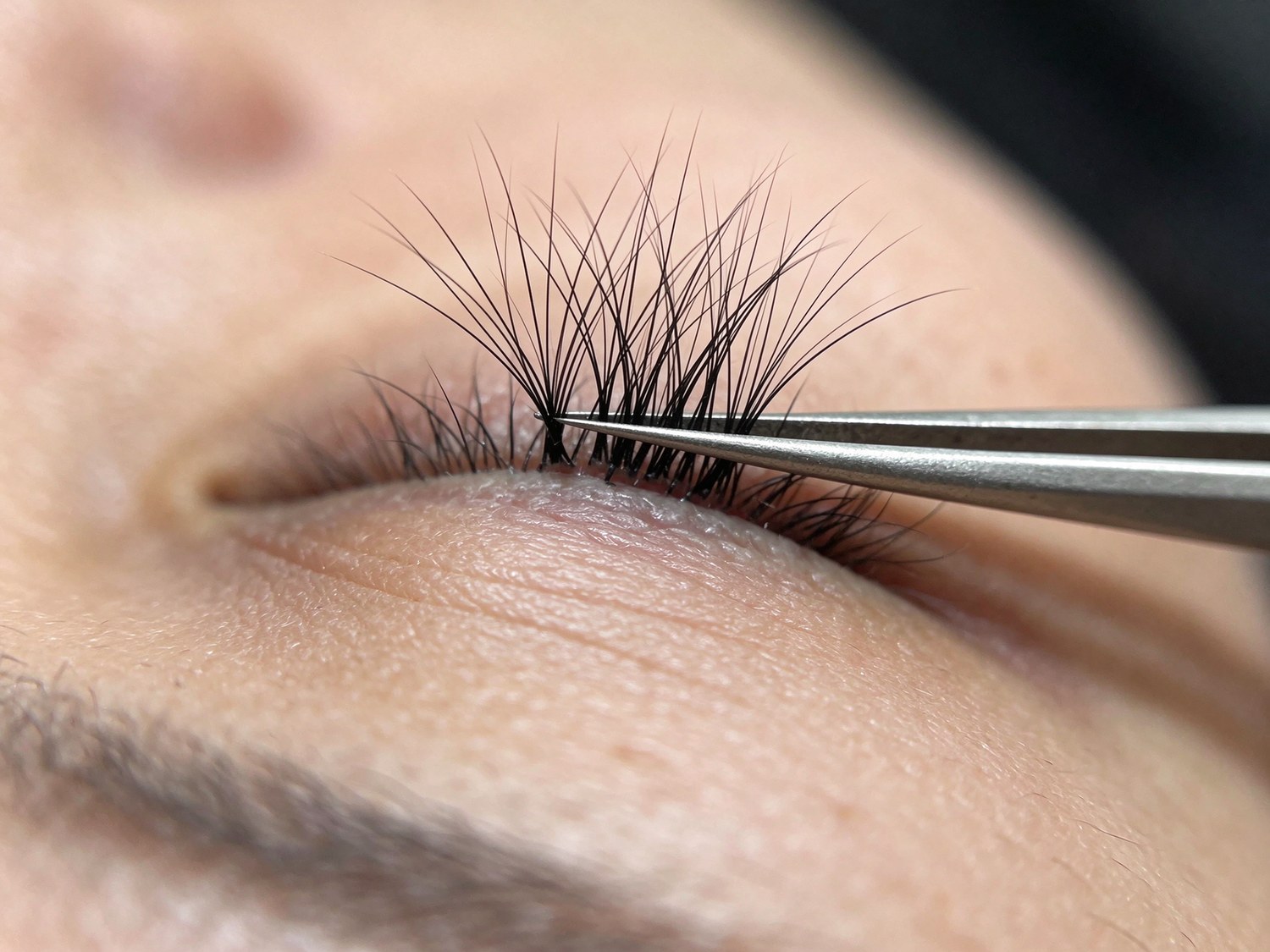
Diameter is the least discussed number in lash work and the one that decides most of the design. Length gets the attention at the consultation, curl gets the attention in the mirror, but diameter is what the natural lash has to carry. Move from 0.07 mm down to 0.03 mm and a fan of the same count weighs roughly a fifth as much, which is the whole reason thin lashes exist.
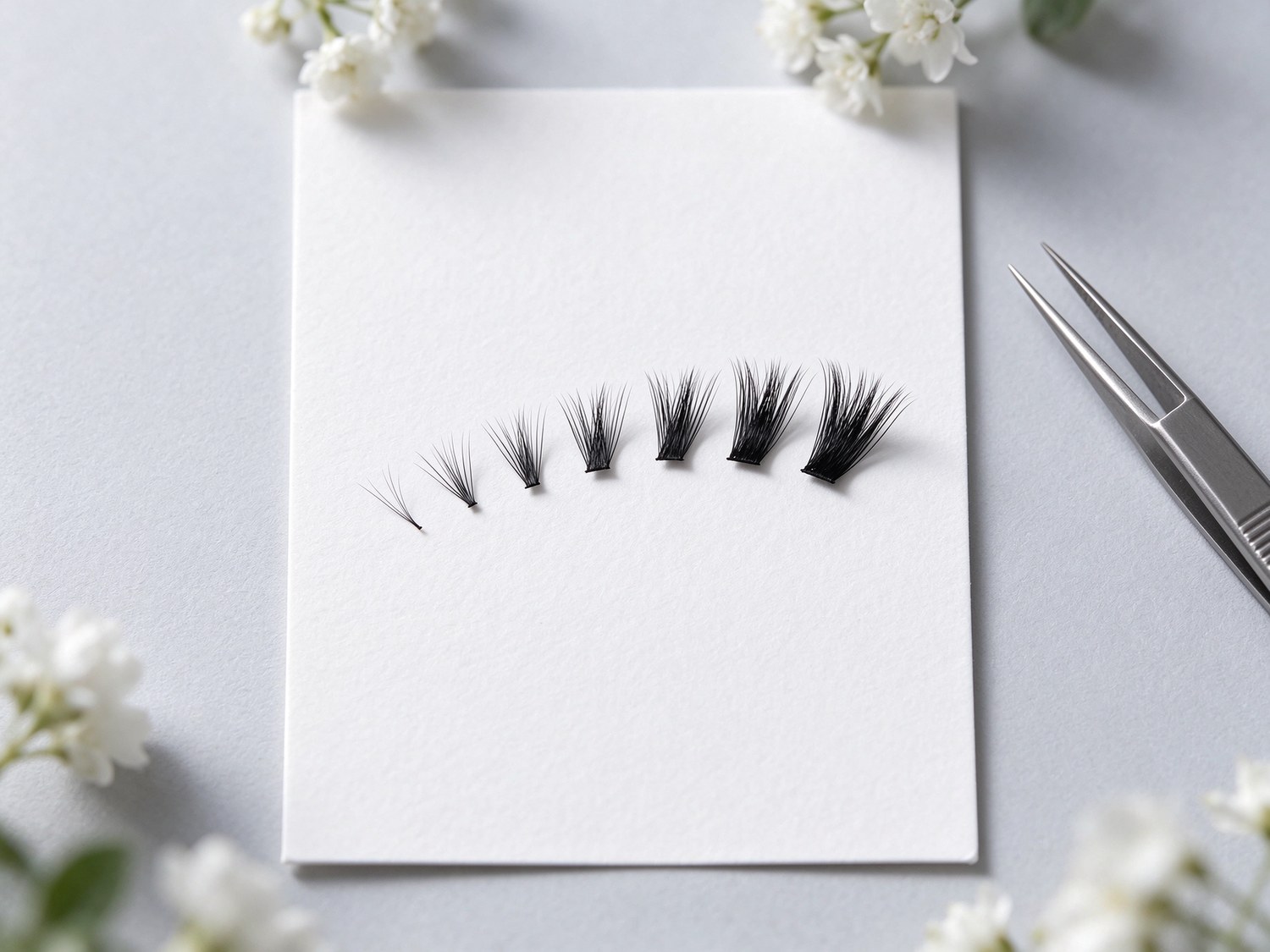
>Why the number matters more than the look
Every extension is added weight on a natural lash that was never designed to carry anything. A single 0.03 mm extension at 10 mm length is a fraction of a milligram; stack seven of them into a fan and the total still sits well under a similar fan built from 0.07 mm lashes. That margin is what lets a stylist build real density on fine or sparse natural lashes without shortening the client’s growth cycle.
The practical result is that thin diameter buys design room rather than a different style. It allows wider fans, more layers, longer lengths on weaker lashes and texture that reads as soft instead of spiky. It does not make a set look thinner. Most clients cannot tell 0.03 mm from 0.05 mm in a finished set; they notice that the set holds better and that the natural lashes underneath still look healthy at the refill.
Where a 0.03 mm lash earns its place
- Volume and mega-volume work. Fans of five to nine lashes become realistic on average natural lashes, and fans of ten or more become possible on strong ones. Thicker lashes at those counts either close the fan into a clump or overload the base.
- Gap filling. Building several thin lashes into a gap, or picking up several natural lashes in one movement, hides a sparse section without adding visible bulk at the base.
- Textured and layered sets. Two tiers at different diameters, with the finer one underneath, give depth that a single diameter cannot.
- Colour gradients. Transitioning from a lighter shade at the inner corner to a darker one at the outer corner is far smoother when each step is a thin lash rather than a heavy one.
- Sensitive or damaged natural lashes. After a bad removal or a long break, thin lashes let a client return to a full look while the natural lash recovers.
The technique it demands
Thin lashes are less forgiving, and the reasons are mechanical rather than cosmetic. They bend under too much adhesive, so the dip has to be shallow and the bead small. They are harder to see against a dark tray, so lighting and a contrasting background stop mattering less than a steady hand. Isolation has to be genuinely clean: at 0.03 mm a lash applied to two natural lashes will not be noticed until it twists a week later.
Base attachment also deserves more care. A wide, thin fan spreads its contact across more of the natural lash, so placement slightly too high or too low shows up as a kink rather than a soft angle. Most stylists find that thin-lash work is slower per fan at first and then faster than volume work at thicker diameters, because the fan builds with less resistance.
What to tell a client who asks
The honest explanation is that thinner lashes are not a cheaper or lesser option. They are the tool that makes a full, textured set possible on lashes that could not otherwise carry it, and they are the reason a set can be built up over several refills instead of arriving at maximum density in one appointment. If a client has been told elsewhere that volume lashes will damage her natural lashes, the diameter is usually the part of the story that was missing.
Keep a note in the client record of the diameters used in each section, and the next stylist, or the same one six months later, can rebuild the identical set instead of guessing from a photograph.