
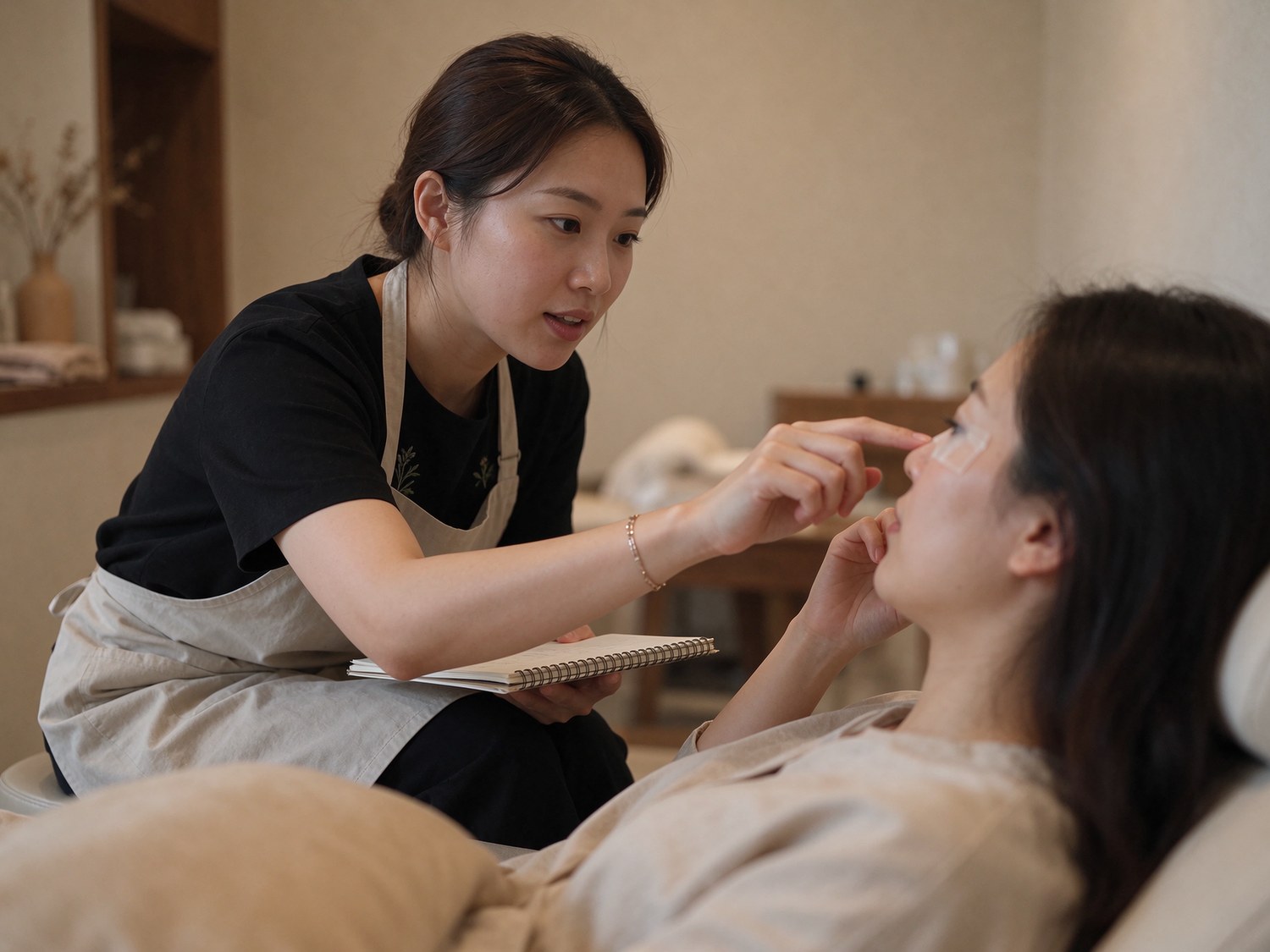
Ask artists why clients leave and the answers are usually about price or moving house. Ask clients and the answer is often vaguer: it just stopped feeling like it was for them. Retention is rarely won with discounts. It is won by making every appointment look like it was planned for one specific person — because it was.

>Why personalisation retains clients
A service matched to the client’s features, hair texture and maintenance habits produces a better experience from the consultation through to the final result. Satisfaction rises, rebooking becomes the obvious next step rather than a decision, and the client has a reason to come back that has nothing to do with a promotion.
The opposite is just as true. One-size-fits-all work — the same shield, the same map, the same aftercare speech for everyone — produces results that look fine in the mirror on the day and feel wrong within a week. Clients rarely complain about that; they simply try somebody else next time.
There is a second benefit that artists often undervalue: a tailored approach demonstrates technical control. When a client can see that you noticed her eye shape, her lash direction and her actual routine, the appointment reads as professional care rather than a transaction. That is the thing people remember when they are deciding where to book.
Five minutes that decide the service
Customisation begins with an assessment, not with a product choice. Five things are worth recording every time, even for regulars:
- Eye shape and lash growth pattern. Where the lashes grow down, outward or upward, and where the lid sits relative to the lash line.
- Brow density and hair texture. How much hair there is, in which direction, and whether it is coarse, fine, sparse or dense.
- Service history and hair condition. Previous lifts, extensions, tints, lamination, chemical services elsewhere — and how the hair responded.
- Desired finish. Natural or defined, soft or dramatic, and what that client means by those words.
- Maintenance commitment. How much time they will realistically spend on the service at home, which decides how much of the design depends on daily styling.
Two minutes of questions and three minutes of looking is enough. What matters is that the answers change what you do next — the shield, the map, the processing time, the aftercare you recommend.
Turn the assessment into a plan
A plan is what separates a personalised service from a friendly one. Before you start, decide and write down: shield or rod size and why, the processing time you will use, the direction you will place the hairs, and the aftercare you will recommend. Two lines on a record card is enough.
That card becomes the most valuable document in your business. It lets you reproduce a result the client loved, adjust one that she did not, and spot changes in lash condition between appointments rather than discovering them mid-service. It also makes you look — and be — consistent, which is the second half of retention.
Make consistency visible
Clients cannot judge technique, but they can judge whether the result is the same as last time. Consistency across appointments is what turns a good first experience into a habit, and it depends on three things your client can actually feel: the same preparation, the same timing discipline, and the same aftercare explanation.
If the product system or the timing changes between visits, say so before the client notices the difference. “I’m using a slightly gentler formula today because your lashes are a little drier than last time” sounds like expertise. Silence followed by a different result sounds like inconsistency.
Match aftercare to the service, not to the shelf
Aftercare that matches what you actually applied is where personalisation becomes practical. A client with a lift needs oil-free cleansing and no steam for the first 24 hours; a client with laminated brows needs to know when conditioning can start for the specific system used; a client with extensions needs a cleansing routine that actually removes residue without pulling.
Hand over only what fits the service. A generic aftercare card that contradicts the product you used is worse than no card, because it teaches the client that the details do not matter.
Where premium value comes from
Personalised work justifies a higher price far more convincingly than a longer service. The value is visible in the consultation, in the plan, in the result and in the follow-up — the client is paying for judgement, not just for time in the chair.
That is also the honest limit: some lashes cannot carry a dramatic set, and some brows cannot be made dense by lamination. Saying so, and designing within the limit, is what makes a premium artist trustworthy. A client who is told the truth about her lashes will believe you about everything else.
Small signals clients remember
- Knowing what they had last time without asking, because it is written down.
- Remembering a sensitivity, a pregnancy, an event they were preparing for.
- Recommending nothing this visit because nothing needed it.
- Booking the next appointment before they leave, while the result is still visible.
None of these is complicated. Together they answer the only question that keeps a client: does this person know me and my lashes? Retention is the accumulated answer to that question.