
Every few weeks a stylist asks for the fastest adhesive on the market, on the assumption that speed equals strength. It is an understandable shortcut: fast sets mean more clients per day, and strong bonds mean fewer complaints. The two do not move together the way the marketing suggests.
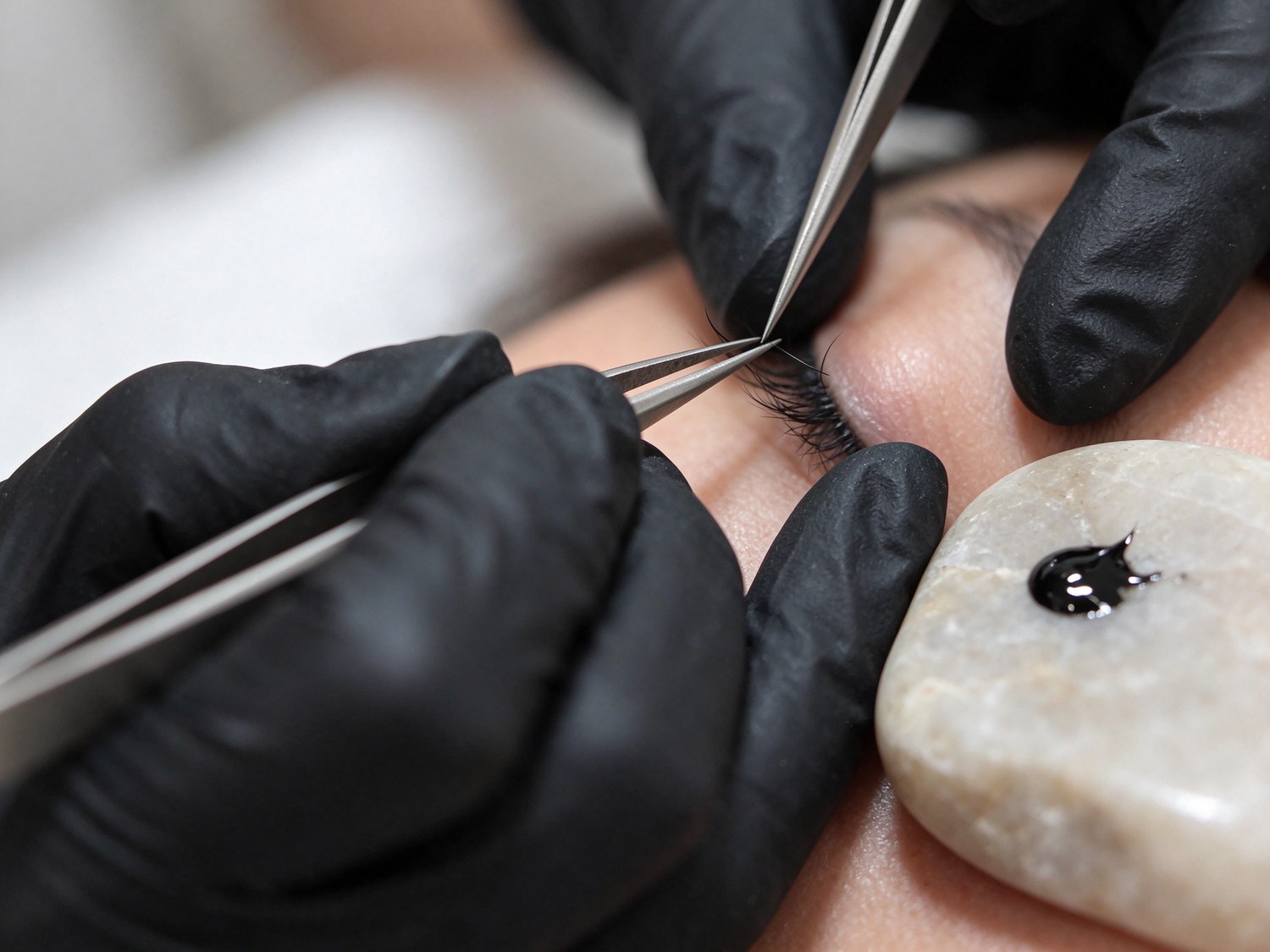
>What actually makes an adhesive fast
Lash adhesive cures when cyanoacrylate reacts with moisture in the air. More reactive monomer and a more aggressive solvent package shorten the time between placement and set. That same reactivity is what produces strength, which is why the two ideas get conflated. But cure speed is only half of the equation; the other half is the humidity and temperature the adhesive is working in.
Every adhesive has a designed window. Below the low end of its humidity range, it sets slowly and stays tacky, so lashes slide and stick to each other. Above the high end, it sets before the extension reaches the natural lash, and the bond forms in the air rather than on the hair. The same bottle can behave like two different products in two different rooms, which is why a hygrometer at the station matters more than the label on the bottle.
Fast is not the same as strong
As cure speed increases, the cured film tends to become more brittle. Brittle bonds fail at the lash line rather than flexing with the natural lash, and they are the ones clients describe as “snapping off” after a week. There is a visible warning sign too: shock polymerization, the chalky white residue that appears when the adhesive cures faster than the solvent can escape. Once you see white dust at the base, the bond is already compromised.
The other failure is simpler and more common. If the adhesive sets in one second and your placement takes two, the extension is already partly cured before it touches the natural lash. The bond looks fine on the bed and fails at day five. No amount of room tuning fixes a pace mismatch.
Measure your own pace first
Before changing adhesives, time yourself. A practical way to do it:
- Set a timer and isolate, dip and place twenty extensions at normal working speed.
- Note the average seconds from leaving the drop to releasing the lash.
- Repeat once on a full set, because the second half of an appointment is usually slower.
- Compare that number with the adhesive’s stated working time, not its marketing claim.
If your placement takes longer than the adhesive’s open time, you need a slower product, not a faster one. If your placement is quicker than the cure, a faster adhesive will not make you faster; it will only remove your margin for adjustment.
Where speed actually comes from
Most of the time saved in a lash appointment does not come from the glue. It comes from the setup:
- Isolation done properly once. Re-taping mid-set costs minutes and breaks concentration.
- Trays pre-sorted by length and curl. Hunting for a 9 mm in a mixed tray adds up across forty placements.
- Fans ready before the drop. Pre-made or pre-fanned sets remove the pause between dip and place.
- A drop that stays fresh. Small drops replaced every few minutes keep viscosity stable; a large drop thickens and slows every placement after it.
- Lighting and posture. A stylist who can see the base without moving her head places faster and more accurately.
Choosing by room, not by reputation
Keep two adhesives: one for the humid summer months and one for the dry winter, and switch when your logged readings move outside the comfortable band, not when a client complains. Record temperature, humidity, adhesive batch and retention at each refill. After six weeks you will have a clear picture of which product works in your room, at your pace, on your client mix.
The strongest adhesive is the one that gives you enough open time to place accurately and cures fully once the lash is where it belongs. Speed is a byproduct of that match, not a substitute for it. LebestPro’s adhesive range is specified by working time and humidity band rather than by “fastest”, which makes that match easier to find and to defend when a set underperforms.