
Most lash artists learn one mapping system and repeat it. It is reliable, it is fast, and it keeps the book full. The problem shows up later: once every set in the portfolio looks the same, price becomes the only thing a new client can compare.
Dimensional lashing takes a different route. Instead of treating a set as a single curl applied at different lengths, it treats depth, texture and direction as design decisions. The finished result reads as bespoke rather than duplicated.
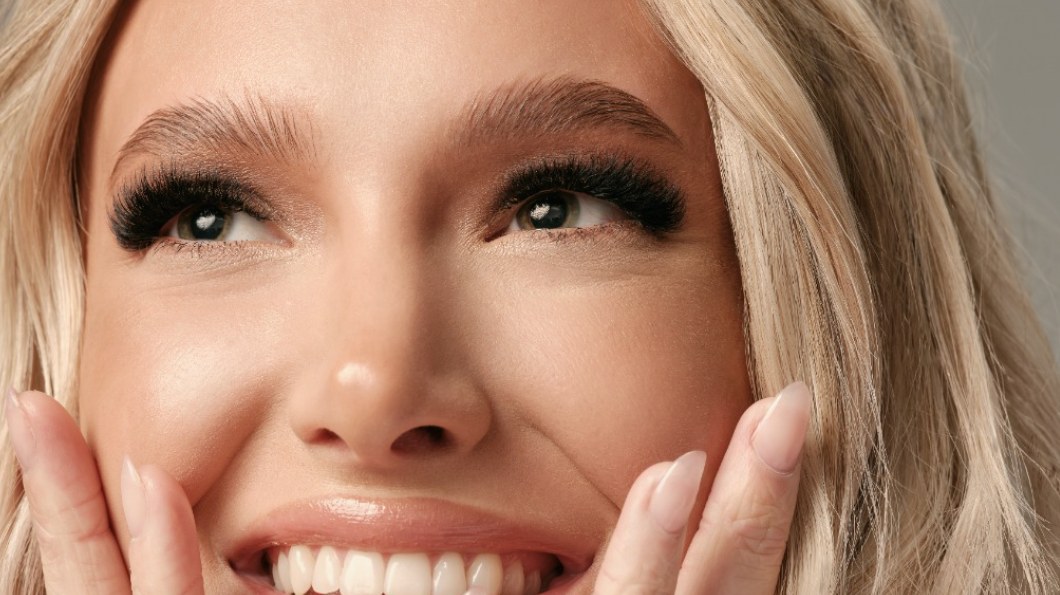
Uniform curls versus mixed-curl sets
A uniform set uses one curl across the whole eye, or across every layer. It is clean and predictable, and for plenty of clients it is exactly right. On certain eye shapes, though, a single flat profile can look heavy, overly symmetrical or simply static on camera.
Mixing curls introduces contrast between the lash line, the middle layers and the tips. Light hits the different angles differently, so the eye gains movement without extra weight.
L curl and M curl: the two workhorses
L curls sit flat at the base and then turn sharply upward. They are the tool for visible lift, and they perform best in layers: a softer curl along the bottom to fill in the line, then L curl above it to pull the set upward and create vertical contrast.
M curls deliver a similar lift with a softer transition angle. The bend is less abrupt, so hooded or deep-set eyes open up without the set looking severe.
Lash capping: two curls on one natural lash
Capping places a light base extension on a natural lash, then stacks a second light fiber above it. It deepens the lash line without adding meaningful weight, as long as diameters stay in the 0.03 to 0.05 range.
Because each layer can carry a different curl, direction and lift are adjusted at the root of a single lash. Some of the most photographed sets of the past year — long, feathered, Arabian-style maps — rely on precisely this technique.
Palette discipline
Juggling several lengths, diameters and curls at once is where most artists lose time. Group by curl strength, keep the softest profile at the top of the tile, and label lengths clearly. Splitting the palette by layer as well as by curl prevents hesitation halfway through a set.
Why it is not standard practice
Dimensional work costs more time and more thinking. It requires a working understanding of how profiles behave in three dimensions, and beginners usually find their first attempts slower than their usual sets.
Start with two curls across the main map and ignore layering. Once that feels automatic, add top, middle and bottom layers. What looks intimidating at the start becomes routine within a few weeks — and the premium pricing that follows is rarely available to artists producing identical sets.
Mixed-curl work suits LebestPro’s curl ranges particularly well: L, M, CC and D profiles in 0.03 to 0.15 diameters, all from a single supplier, so the whole palette can be restocked in one order.